

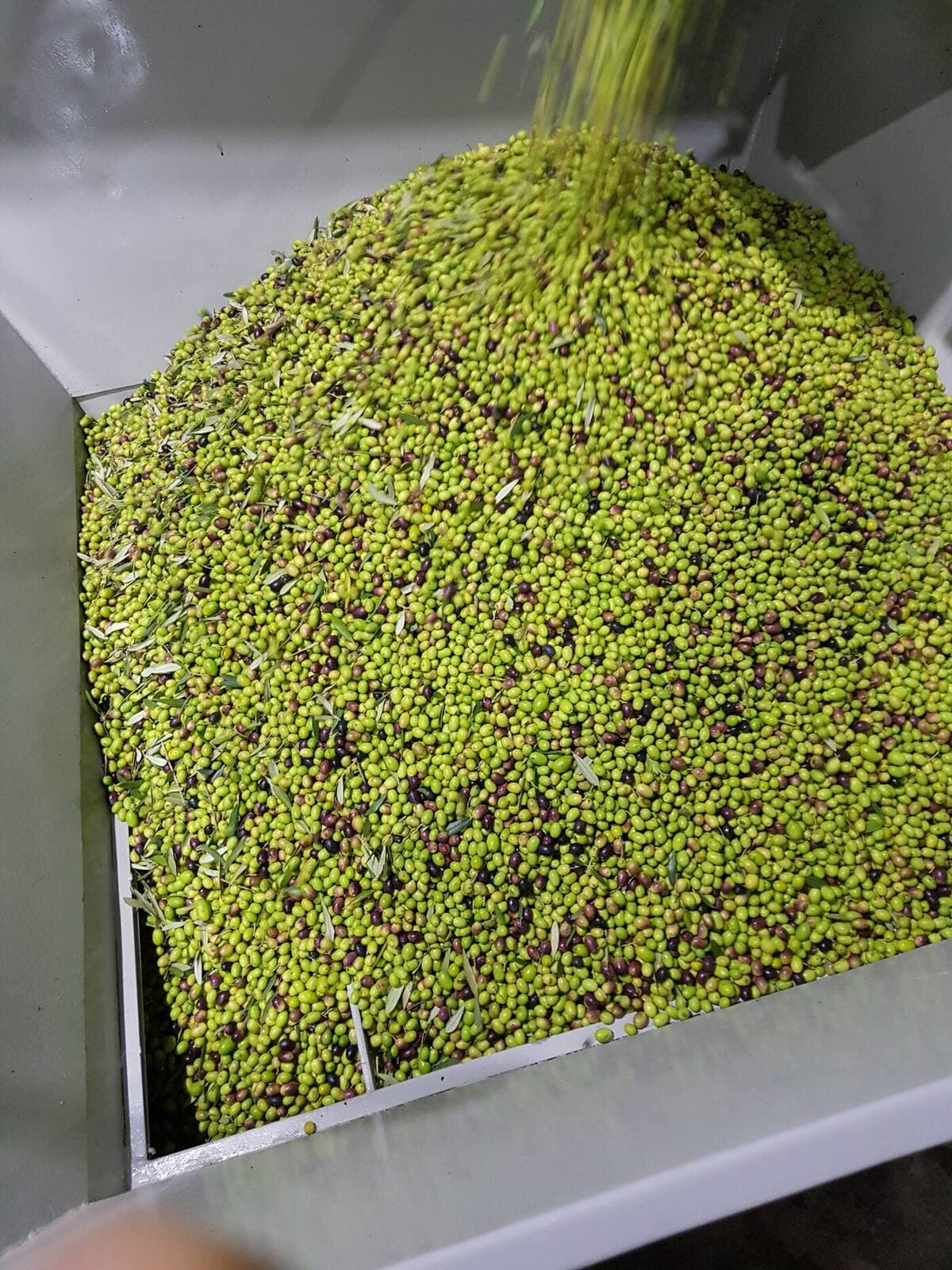
Have you ever wondered how extra virgin olive oil is made? Behind a bottle there is a year of work, dozens of technical choices and a handful of decisive hours in the oil mill. We'll tell you about the complete process, as we've been doing it in Circello for four generations.
First phase: the plant and the olive grove (all year round)
The oil begins nine months before the harvest: with the care of the olive grove.
- Winter pruning (January-March): regulates the foliage, favors light, prepares production
- Green manures and organic fertilization: legumes sown among the olive trees which fix nitrogen in the soil. No chemical fertilizers.
- Phytosanitary defense: in organic farming, constant monitoring of the oil fly (Bactrocera oleae), the main enemy of olives, and treatments with natural products (kaolin, protein baits)
- Emergency irrigation in the hottest months if the summer is extreme
Second phase: the ripening of the olives (August-November)
Olives change composition as they ripen. The three key transformations:
- Decrease in chlorophyll: the color goes from bright green to straw-green to purplish to black
- Increase in polyphenols up to a peak, then decrease if ripening progresses too far
- Increase in oil content: an unripe green drupe has less oil than a ripe drupe
The ideal time for harvesting is a compromise: a little before peak oil (to maximize polyphenols) but not too early (low yields). Each cultivar has its own window: for us the Ortice is at the end of October, the Leccino a few days later.
Third phase: harvest (October-December)
Three main methods:
- Hand cutting: top quality - no damage - but expensive. We use it for our monovarietals.
- Mechanical combing: electric combs, the olives fall onto the nets. Good quality/efficiency compromise.
- Shaking: a machine shakes the tree, the olives fall. Faster, but more impact on the plant.
The olives go to the mill within a few hours: with each hour that passes, some polyphenols degrade and the acidity rises. The ideal is to carry out the milling every evening with the olives harvested during the day.
Fourth phase: the oil mill (the same day)
The process in the oil mill is where an oil is made or ruined:
- Defoliation and washing: a machine removes leaves, earth, twigs. The olives are washed with clean water. Modern washing machines provide a final shower with clean water.
- Crushing: the olives are crushed. Stone millstones (traditional, rare today) or hammer crushers (more widespread, efficient).
- Kneading: the olive paste obtained is mixed slowly for 30-40 minutes, at a controlled temperature below 27°C. This is the critical phase: the heat here would ruin the polyphenols.
- Extraction: a centrifuge (decanter) separates the oil from the vegetation water and the pomace. No solvents, no pressure: only centrifugal force.
Golden rule: temperature ≤ 27°C throughout the process. It is the legal limit to be able to declare "cold extraction".
Fifth phase: filtering (immediately after)
The freshly extracted oil is turbid: it contains microparticles of must, vegetation water, plant fragments. Leaving it cloudy is a choice that may seem "natural" but on a technical level it causes problems:
- The residues ferment over time, generating sensory defects (heating, sludge)
- The residual vegetation water accelerates oxidation
- After 2-3 months the sediment settles making the oil less pleasant
Serious producers filter with cardboard or natural light filters, keeping the aromas intact and prolonging the shelf life.
Sixth phase: conservation (months)
The freshly made oil must be stored in stainless steel tanks, under a blanket of inert gas (nitrogen or argon) to prevent oxidation. Alternative: always full tanks with float caps that prevent contact with air.
Ideal warehouse temperature: 14-18°C, stable, in the dark. Above 20°C all degradation processes accelerate significantly.
Seventh phase: bottling (on request)
Our oils are bottled only when ordered or in small batches, to guarantee freshness. The bottle (dark glass) or can (metal) protects against oxidation and light.
On the bottle you will find:
- Category ("extra virgin olive oil")
- Origin (country, region or PDO area)
- Harvest year
- Batch number (traceability)
- Minimum shelf life (18-24 months)
Frequently asked questions
How much time passes between olive harvesting and bottling?
The pressing takes place within a few hours of harvesting (ideally the same evening). The oil then remains in the stainless steel tanks for a few months to stabilize and lose its natural cloudiness. Bottling usually takes place from January onwards, and can continue throughout the following year.
What does "cold extraction" mean?
It means that during kneading and extraction the temperature of the olive paste remains below 27°C. It is a legal limit: above this temperature the more delicate polyphenols degrade. "Cold pressing" is a variant of the term used for discontinuous system mills (with presses).
Is cold-pressed oil better than hot-pressed oil?
Yes, definitely. Hot extraction increases the yield (more oil from the same amount of olives) but degrades the polyphenols, aroma and nutritional properties. Only "cold" can it be called quality extra virgin olive oil.
Why don't some manufacturers filter?
Often for marketing reasons ("raw, natural oil"). On a technical level, filtering increases the stability and shelf life of the oil. An unfiltered oil is pleasant in the first 2-3 months, then the must residues ferment causing defects.
How many liters of oil are obtained from one kg of olives?
It depends on the variety, ripeness and vintage. On average: 12-18 liters of oil per 100 kg of olives. Native cultivars such as Ortice tend to have lower yields (more quality, less quantity) than lowland varieties.